Morning light along the coast
CLYNE RESEARCH

A little more understanding.
A life with more possibility.

AI-generated brand film · Higgsfield
LIVE AHEAD. STAY CURIOUS.

Understand more. Live ahead.

Original papers. Clear explanations. A conversation about what comes next.

Explore the evidence.

15 papers to explore · original sources

THE TAKEAWAY · THIS PAPER

In adults who usually slept less than 6.5 hours, help extending sleep led to lower food energy intake over two weeks. This suggests sleep deserves a place in the conversation about weight and appetite. A small, short trial.

01 / 15
01
JAMA Internal Medicine · 2022

Could more sleep change how much you eat?

JAMA Internal Medicine logoJAMA Internal MedicineOriginal paper · 2022 · 10 pages
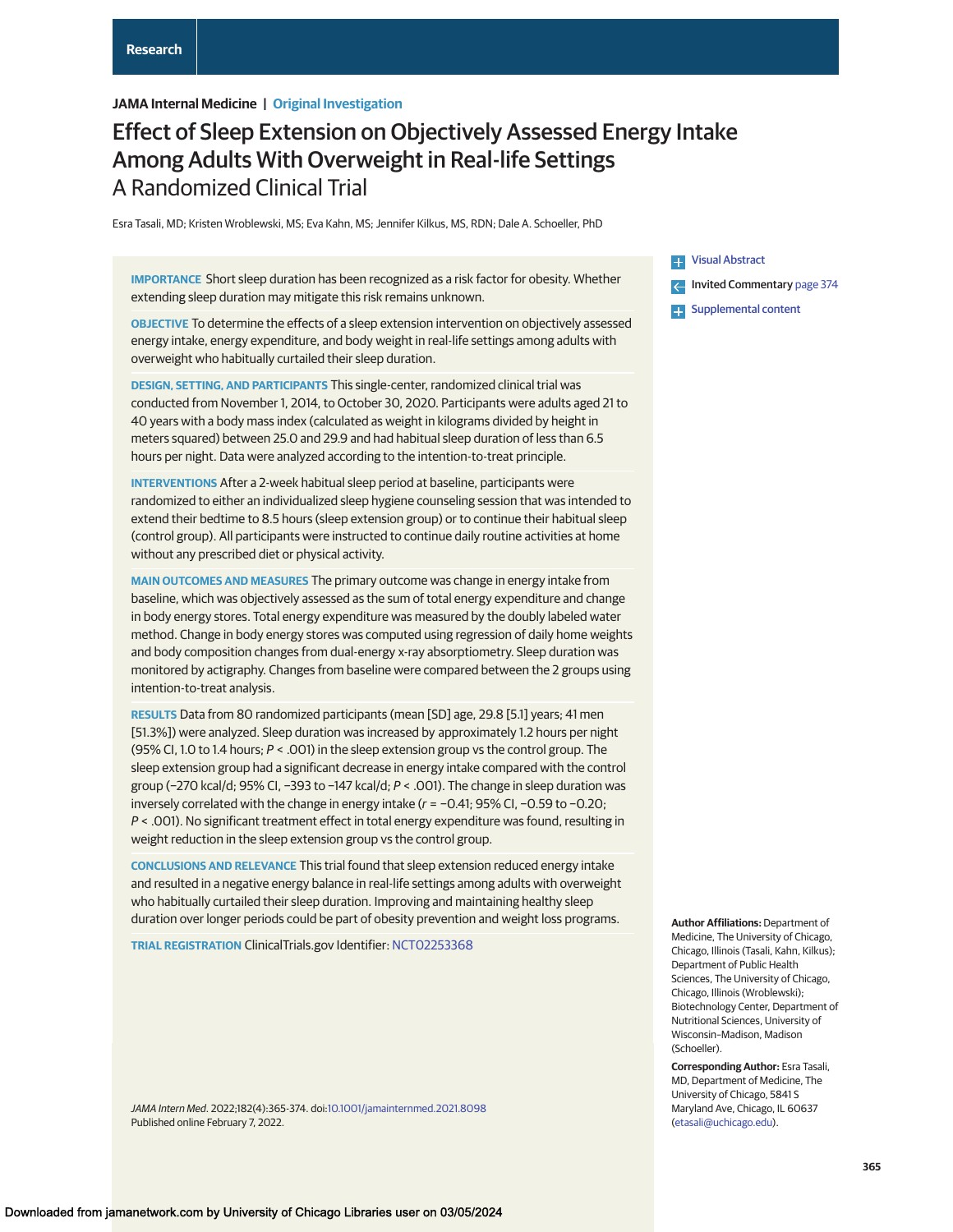
Original published paper, page 1: Effect of Sleep Extension on Objectively Assessed Energy Intake Among Adults With Overweight in Real-life Settings: A Randomized Clinical Trial
CC BY 4.0 · Original sourcePublication ↗
IN PLAIN ENGLISHPaper excerpts

This randomized trial found that adults with overweight who habitually slept less than 6.5 hours per night and were coached to extend their sleep to about 8.5 hours in bed ate roughly 270 fewer calories per day than a control group over two weeks, with no significant change in energy expenditure and a small resulting weight decrease. The sleep extension group's actual sleep increased by about 1.2 hours per night compared with controls. Sleep duration increased ~1.2 hours/night (95% CI 1.0-1.4) in the sleep-extension group versus controls, and energy intake decreased by 270 kcal/day (95% CI −393 to −147) compared with controls over 2 weeks. Total energy expenditure did not differ significantly between groups, but the sleep-extension group lost 0.87 kg more weight than controls (95% CI −1.39 to −0.35 kg), with the control group gaining 0.39 kg and the sleep group losing 0.48 kg.

This full-paper evidence overview of a single trial suggests behavioral sleep extension counseling may be worth discussing as one piece of broader obesity-prevention conversations, alongside diet and activity; it does not establish long-term outcomes or apply to people outside the studied age/BMI/sleep-disorder criteria. This is not a recommendation for any individual to start or change sleep, diet, or medical treatment.

Study details & limits

Single-center randomized clinical trial (2014–2020) of 80 adults aged 21-40 with BMI 25.0-29.9 and habitual sleep under 6.5 hours/night, without sleep apnea, insomnia, or shift work. After a 2-week baseline, participants were randomized to sleep-extension counseling (aiming for 8.5 hours in bed) or continued habitual sleep for 2 weeks, living at home with no prescribed diet or exercise. Energy intake was calculated objectively via doubly labeled water and body composition changes, not self-report; this was a fully randomized, short-term (4-week total) trial, not observational follow-up.

Across all participants, each 1-hour increase in sleep duration was associated with about 162 fewer kcal/day (95% CI −247 to −78), showing a dose-related inverse correlation (r=−0.41).

The trial was short (2-week intervention) in a narrowly defined population (ages 21-40, overweight only, no sleep apnea/insomnia/shift work), limiting generalizability to broader or more diverse groups, and it's unclear how long sleep changes or weight effects would be sustained.

Energy intake was inferred indirectly (doubly labeled water has ~5% measurement uncertainty) rather than directly observed, and the control group's own energy intake and weight rose from baseline, which may have amplified the between-group difference.

No adverse effects were specifically reported since this was a behavioral counseling intervention (not a medication), and the study reports no conflicts of interest, funded by NIH and a university center with no sponsor role in design or analysis.

AI explanation · paper excerpts.

MAKE IT PERSONAL

How long can sleep-extension behavior changes and any weight effects be sustained beyond 2 weeks?

Europe PMC biomedical discovery · Crossref journal discovery · Full text varies by access